You’re ready to launch your token. But one decision stands between you and launch day: token creator vs custom development. Do you move fast with a no-code platform, or invest months in building a custom smart contract from scratch?
Choose wrong, and you risk security gaps, painful migrations, or budgets spiraling out of control. Choose right, and you can beat competitors to market while protecting both your code and your treasury. So how do you decide between a token creator vs custom development approach, and which one actually fits your project?
What You’re Actually Choosing Between?
Token Creators = No-code platforms with drag-and-drop interfaces. You can think it like Shopify for tokens. You can Launch in mintues and even zero coding requirement.
Custom Development = Hiring developers to write smart contracts from scratch in Solidity. You have full control, but expensive and slow.
One critical point that “Custom” doesn’t mean reinventing the wheel. Smart developers use battle-tested libraries like OpenZeppelin for security basics. They customize the business logic that makes your project unique
The Numbers Don’t Lie

Real impact: Token creator vs custom development is often a tradeoff between speed and control. Token creators can reduce development time by 80–90%, but that speed comes with strings attached.
When Token Creators Win?
Use a platform if you need:
• Fast market validation: Launch your MVP in 48 hours to test demand before investing serious capital.
• Standard functionality: Basic ERC-20 tokens or simple NFTs work perfectly on platforms.
• Cash preservation: Bootstrapped startups can spend on marketing instead of developers.
Real example: A gaming startup used a token creator to launch reward tokens in 3 days. Validated user demand. Raised $500K. Then built custom infrastructure.
When Custom Development Is Non-Negotiable?
Go custom if you have:
• Proprietary algorithms: Your competitive edge relies on unique staking math or complex tokenomics.
• Regulatory requirements: Healthcare or finance projects need HIPAA/GDPR compliance built into smart contracts.
• Scale ambitions: Planning for thousands of concurrent users requires optimized, custom code.
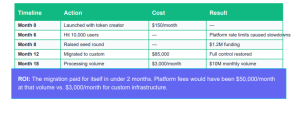
“We tried a token creator for our DeFi protocol. Hit the platform’s limits in week two. Migration to custom code took 8 months and $180K.” — CTO, DeFi lending platform
The Security Reality Check
Platform Risk vs. DIY Risk
Token creators: You share infrastructure with thousands of projects. One platform breach exposes everyone. You can’t control server locations or security protocols.
Custom contracts: You agreed that human error is your enemy. Storage collisions and initialization bugs have caused over $400 million in losses historically.
The Audit Question
Token creator: Platform handles security hopefully. It depends on the trust and authority of the platform. So, stay away from the red flag token creation sites.
Custom contract: You pay $5,000-$15,000 for professional audits. Not any optional and the story doesn’t end here because it include all the frontal charge. Now, You need to audit the code, the upgrade mechanisms, and admin controls.
The Hidden Costs Everyone Forgets
Short-Term vs. Long-Term
Month 1: Token creator costs $50. Custom costs $50,000.
Month 12: Token creator costs $600 + $5,000 in workaround fees for features they don’t support. Custom costs $50,000 total.
Month 24: Need to migrate from the platform? Add 3-12 months and $30,000-$100,000 for rebuilding, data migration, and running parallel systems.
Technical Debt Is Real
1.5% of real-world smart contracts contain self-admitted technical debt (SATD). It happens when teams choose quick fixes over robust solutions.
Outgrowing a no-code platform means starting over. You’ll rebuild every integration, migrate user data, and test everything again.
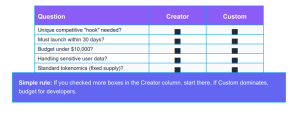
Decision Framework: Your 60-Second Clarity Tool
Industry Trend: The Hybrid Approach
The smartest teams in 2026 start hybrid:
1. Weeks 1-4: Launch with a token creator. Test market fit.
2. Month 2-3: Gather user feedback and usage data.
3. Month 4+: Build custom infrastructure based on proven demand.
This approach minimizes risk and preserves capital while maintaining speed
Case Study: From No-Code to $10M in 18 Months
Checklist: Before You Launch
For Token Creators:
■ Verify platform has SOC 2 compliance
■ Check exit strategy (data export options)
■ Review usage limits and pricing tiers
■ Test customer support response time
■ Confirm blockchain compatibility
For Custom Development:
■ Budget for 3rd-party security audit
■ Plan upgrade mechanism (proxy patterns)
■ Document all admin keys and controls
■ Set up testnet deployment first
■ Establish code review process
Frequently Asked Questions
Is launching a token without developers legal?
Yes, but compliance is your responsibility. Ensure your token isn’t classified as an unregistered security. Follow KYC/AML laws in your jurisdiction.
How much does a smart contract audit actually cost?
Professional audits range from $5,000 to $15,000 for custom contracts. Budget for this; it’s not optional if you’re handling user funds.
Can I migrate from a token creator to custom code later?
Yes, but in a token creator vs custom development scenario, migration is one of the hardest paths. It usually involves exporting data, rewriting logic in Solidity, and running both systems in parallel. Expect 3 to 12 months of engineering and testing.
What are the biggest risks with no-code platforms?
Limited flexibility as you scale. Vendor lock-in. Performance bottlenecks during traffic spikes. You’re dependent on one company’s infrastructure.
When do I need a developer even with a token creator?
Even in a token creator vs custom development setup favoring no-code, developers become necessary when you need custom integrations, unique business logic, or features outside standard templates. Many teams hire developers part-time for targeted enhancements.
Take Action: Your 3-Step Plan
Step 1: Score your project using the token creator vs custom development decision framework (under 5 minutes)
Step 2: Run the numbers on your 12-month cost projection, including hidden fees
Step 3: Make the call and commit. Switching paths mid-build in a token creator vs custom development setup is the most expensive option
In the token creator vs custom development debate, the token that launches tomorrow beats the perfect token that launches never.
What’s your first move?